


If you were watching your screens during market close today, you likely rubbed your eyes in disbelief. At 3:30 PM, Nifty suddenly flashed a massive print to close at 24,774, while Nifty Futures barely budged and option premiums behaved erratically.
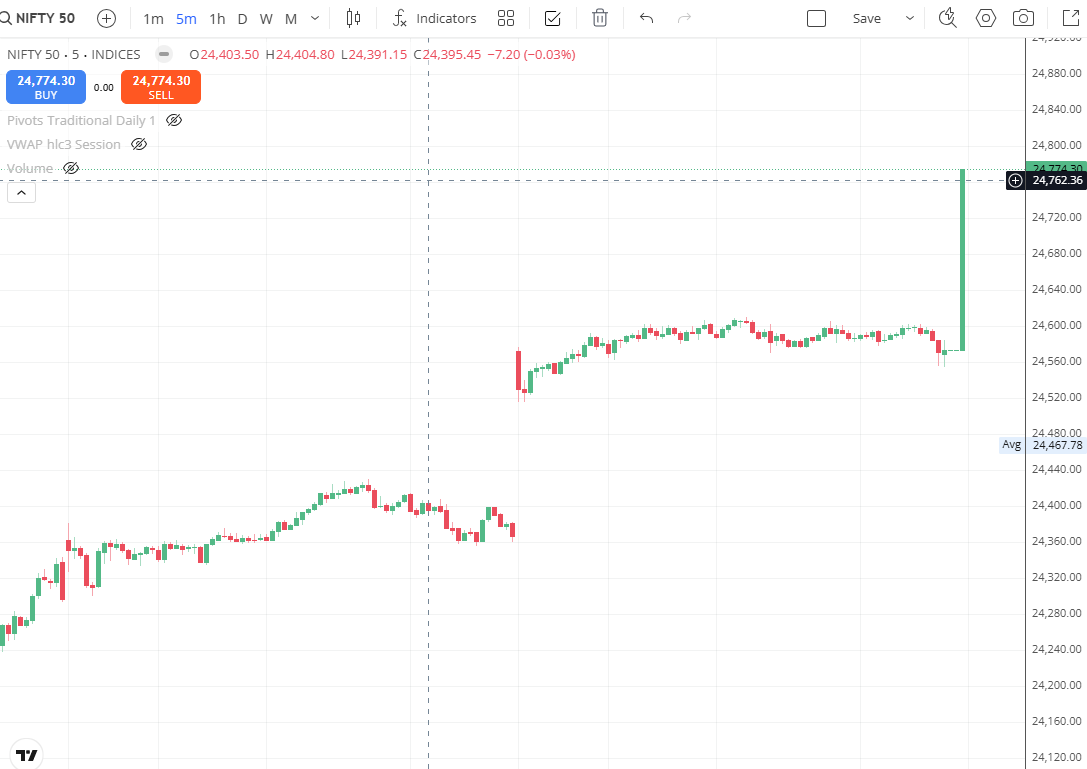
Social media blew up instantly with confusion: Was it a fat-finger trade? A ticker glitched? Did someone manipulate the index close?
The answer is none of the above. What you witnessed was the live debut of the Closing Auction Session (CAS) on the National Stock Exchange (NSE).
Here is a simple, straightforward breakdown of why this disconnect happened, what CAS actually is, and how to protect yourself going forward.
1. The Old Way vs. The New CAS Rulebook
To understand today’s move, we first need to look at how closing prices used to be calculated versus how they are done now.
OLD SYSTEM (Pre-August 2026):
[3:00 PM - 3:30 PM] ──> 30-Min Volume Weighted Average (VWAP) ──> Official Close

NEW CAS SYSTEM (Rolled Out Today):
[3:00 PM - 3:15 PM] ──> Reference VWAP Calculation
[3:15 PM - 3:35 PM] ──> Closing Auction Session (Single Execution Price)
[3:15 PM - 3:40 PM] ──> Extended F&O Trading Window
-
The Old System: The closing price was simply the 30-minute Volume Weighted Average Price (VWAP) between 3:00 PM and 3:30 PM.
-
The New CAS System: Continuous trading for F&O-eligible cash stocks now halts early at 3:15 PM. From 3:15 PM to 3:35 PM, all buy and sell orders for those heavyweights are pooled into a call auction. The exchange’s algorithm matches them to discover a single equilibrium price where maximum volume clears within a +-3% band.
2. Why Did Spot Nifty Spike to 24,774 While Futures Stayed Flat?
This was the central source of confusion. The disconnect was caused by a timing split and structural order matching, not a physical market rally:
-
Institutional Order Bundling in the Auction: Between 3:20 PM and 3:30 PM, passive index funds, institutional execution algorithms, and market makers submitted large buy-side imbalances into the cash auction pool to rebalance positions.
-
Artificial Equilibrium: Because no continuous trades happened to absorb these orders gradually, the CAS algorithm calculated a higher single clearing price (24,774) to clear the maximum number of matched shares.
-
Futures Trades the “Real” Sentiment: While cash stocks were locked in an auction pool until 3:35 PM, F&O contracts continued trading independently until 3:40 PM. F&O traders recognized that the 24,774 cash print was an isolated artifact of an auction algorithm matching batch volume—not a sudden surge in underlying demand. Consequently, futures traders refused to chase the basis higher.
3. What Does This Mean for Your Trades?
The operational mechanics of trading the final 30 minutes have fundamentally changed:
| Category | Impact | What You Need to Watch |
| Intraday Square-offs | Earlier Cutoffs | Intraday auto square-offs (MIS/CO) for F&O stocks now trigger earlier (~3:10 PM) since regular cash trading stops at 3:15 PM. |
| Option Buyers / Sellers | M2M Squeeze Risk | Final option contract values on expiry days will settle against the CAS-discovered index value, not the Last Traded Price (LTP) you see on screen at 3:29 PM. |
| STBT / BTST Traders | Price Slippage | Carrying positions overnight based on the 3:14 PM price can result in unexpected mark-to-market gaps once the 3:35 PM official CAS print is published. |
4. Playbook: How Traders Should Adapt
-
Don’t Trade Futures Based on Late Spot Prints: Never assume futures will automatically converge to a late-flashed cash price during the 3:15–3:35 PM window. Futures reflect continuous market sentiment; CAS reflects a batch match.
-
Watch the Indicative CAS Data: During the auction order entry window (3:20 PM – 3:30 PM), exchanges stream an Indicative Equilibrium Price and Order Imbalance Quantity. Keep an eye on these depth metrics to anticipate where the final spot price will land.
-
Wrap Up Intraday Orders Before 3:10 PM: If you trade cash equities intraday, treat 3:10 PM as your new hard exit. Waiting until 3:14 PM risks getting caught in spread widening right before the auction lock.