


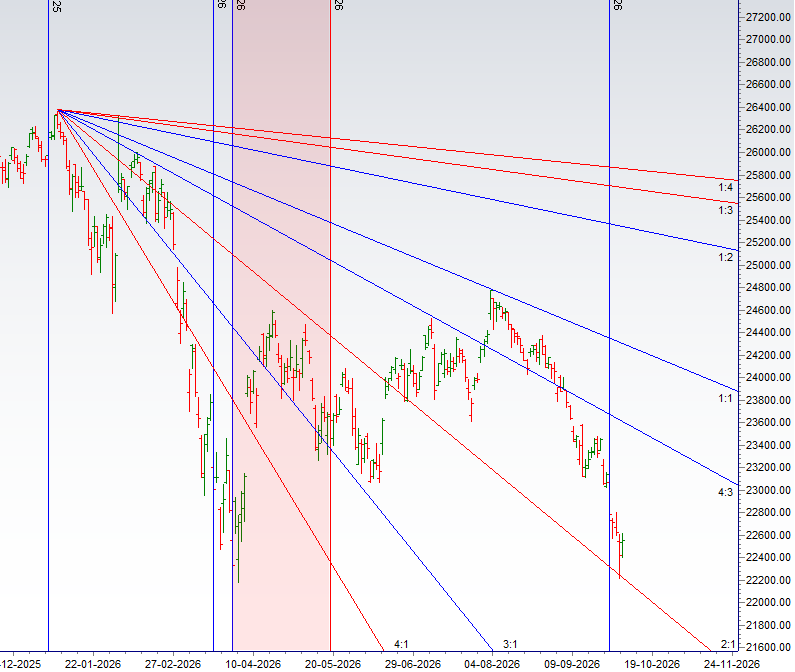
Nifty staged a rebound on October 5, 2026, gaining 90 points within a 219-point intraday range to settle at 22,555. The recovery validated the projected October 5 time cycle pivot, carving out a constructive higher-high and higher-low formation on the daily chart.
The technical setup intersects with a significant planetary alignment: Bayer Rule 21 (Variation C), which states that strong directional expansions typically unfold within a 5-to-8 day window when retrograde Venus forms a conjunction with retrograde Mercury. Because both are inner planets, this configuration frequently triggers sharp short-term momentum shifts. With upward momentum intact while holding above the 22,343–22,400 base, bulls now face the immediate task of securing a daily close above 22,610 to unlock targets toward 22,768 and 22,969.
Institutional Derivatives & Cash Flow Matrix
Derivatives positioning points to short covering from Foreign Institutional Investors (FIIs) following prolonged one-sided positioning:
-
FII Index Futures Flow: FIIs turned net buyers in Nifty Index Futures, absorbing 6,810 contracts worth ₹1,001 crore. Gross flows show FIIs covered 488 long contracts and covered 8,271 short contracts. This aggressive unwinding led to a net open interest decline of 7,152 contracts, shifting their net Long-to-Short positioning to 08:92 (Ratio: 0.08).
-
Client / Retail Behavior: Retail participants booked profits on the rebound, covering 4,879 long contracts while initiating 2,900 short contracts. Despite the trim, their positioning remains heavily loaded on the long side at 84:16 (Ratio: 5.05).
-
Cash Market Divergence: In the cash segment, FIIs remained net sellers with outflows of ₹4,699 crore, which were absorbed by Domestic Institutional Investors (DIIs) with net inflows of ₹5,181 crore.
-
Futures OI & Cost of Carry: Total futures open interest volume settled at ₹1.90 lakh crore, recording a liquidation of 1.4 lakh contracts. The simultaneous drop in open interest alongside an expanding Cost of Carry confirms that institutional short covering fueled the day’s bounce.
-
Breadth & Rollover Benchmark: Market breadth improved significantly, with the Advance-Decline ratio settling positive at 31:18. However, the index continues to trade below the monthly Rollover Cost mark of 23,156, keeping higher-timeframe resistance intact.
Option Chain Structure (CMP: 22,555)
The derivatives distribution reveals a balanced immediate playing field with an upward pull from the Max Pain strike:
-
Put-Call Ratio (PCR): 0.92, showing steady recovery from oversold territory and room for further upside without being overextended.
-
Max Pain: 22,550, aligning directly with the current market close.
-
Major Resistance (Highest Call OI): 22,700 marks the primary overhead supply ceiling for the series. Intermediate call writing stands active across 22,600–22,650.
-
Major Support (Highest Put OI): 22,300 provides solid structural option underwriting, backed by intermediate put writing at 22,400–22,500.
Technical & Astro Confluence
The structural price action is interacting directly with the astro-cycle roadmap:
-
The Support Floor (22,343–22,400): This cluster serves as the primary base for the bullish structure. As long as price action respects this range on any intraday pullback, the bias remains oriented toward upside expansion.
-
The Breakout Trigger (22,610): Bulls require a decisive daily close above 22,610 to clear intermediate overhead resistance. A breakout here confirms the expansion leg toward 22,768, with secondary extension potential toward 22,969.
-
Bayer Rule 21 Ingress: Conjunctions between retrograde inner planets often spark rapid trend acceleration or volatility expansion. The 5-to-8 day post-conjunction window favors quick, trending legs rather than choppy consolidations.
Actionable Trading Scenarios & Strategy Framework
Nifty Futures Positional Framework:
-
Positional Trend Change Level (TCL): 22,691 (Nifty Futures). Positional longs gain structural traction once price trades and holds above 22,691, aligning directly with institutional short-covering momentum.
-
Invalidation Level: A sustained daily close below 22,343 invalidates the reversal thesis, opening the path for a retest of lower demand zones.
Nifty Futures Intraday Framework:
-
Intraday Trend Change Level: 22,635.
-
Strength (Upside Trigger): Intraday momentum strengthens if Nifty Futures sustain above 22,636.
-
Upside Targets: 22,686, 22,737, and 22,787.
-
-
Weakness (Downside Trigger): The immediate trend weakens if the futures contract slips below 22,611.
-
Downside Targets: 22,586, 22,536, and 22,486.
-
Intraday Time Reversal Windows
Monitor price behavior, candlestick reactions, and volume absorption around these intraday time windows:
-
10:28 AM (Opening range settlement and primary inflection)
-
12:42 PM (Midday liquidity shift and European alignment)
-
02:28 PM (Pre-close trend continuation or squaring drive)
Maintain strict discipline with position sizing. With FIIs beginning to cover heavily concentrated short positions alongside the Bayer cycle activation, respect the 22,635 intraday pivot and trade strictly in the direction of the confirmed trigger.