


Market structure changes dictate execution strategy. The exchange has fundamentally altered the end-of-day trading mechanics for specific equities, shifting from standard continuous matching up to 3:30 PM to a structured Closing Auction Session (CAS).
For active traders, understanding these micro-structural changes is critical. If you are trading CAS-eligible stocks, the traditional rules of engagement in the final 15 minutes no longer apply. Here is a technical breakdown of the new timeline and what it means for your risk management protocols.
The Securities and Exchange Board of India (SEBI) is implementing the Closing Auction Session (CAS) to improve how the final price of a stock is determined at the end of the trading day. The closing price is a critical metric used for settling derivatives, calculating mutual fund and ETF Net Asset Values (NAVs), and valuing institutional portfolios.
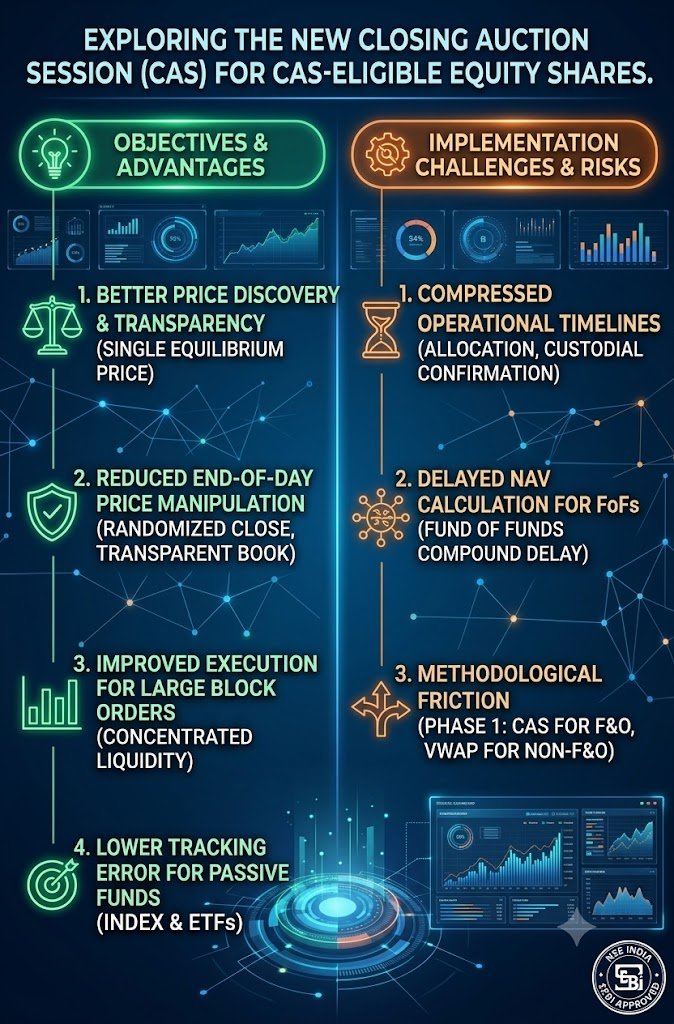
Here is a breakdown of the objectives, advantages, and potential disadvantages of this new system:
Objectives and Advantages of CAS
The primary goal of CAS is to make the closing price more transparent, efficient, and resistant to manipulation.
-
Better Price Discovery & Transparency: Under the previous system, the closing price was based on the Volume Weighted Average Price (VWAP) of the last 30 minutes of trading. CAS replaces this with a single, dedicated auction window where all eligible buy and sell orders are pooled together. The exchange determines a single “equilibrium price” where the maximum number of shares can be traded. This uniform process better reflects the overall, collective market demand and supply rather than just looking at isolated, individual trades.
-
Reduced End-of-Day Manipulation: In the VWAP system, large trades or sudden spikes in buying/selling during the final minutes could disproportionately influence the closing price. CAS mitigates this risk through a transparent auction and by closing the order entry window at a randomized time (between 3:28 PM and 3:30 PM), which discourages last-second order flooding to game the price. Data indicates that CAS provides a more stable and less volatile closing price than VWAP.
-
Improved Execution for Large Orders: CAS allows institutional investors and mutual funds to execute large block trades efficiently at a well-discovered, uniform price. The concentrated liquidity in the auction reduces the price disruption that a massive order might cause during continuous trading. This also provides a transparent alternative to pre-negotiated block deals, reducing the risk of information leakage.
-
Lower Tracking Error for Passive Funds: Because the CAS closing price is more representative of actual market consensus, index funds and Exchange Traded Funds (ETFs) can track their benchmark indices much more accurately.
-
Alignment with Global Standards: By adopting CAS, Indian markets are aligning with the practices used by leading global exchanges, such as the New York Stock Exchange (NYSE) and the London Stock Exchange (LSE).
Potential Disadvantages and Challenges
While generally viewed as a positive structural improvement, the implementation of CAS does present some logistical challenges:
-
Compressed Timelines for Post-Trade Operations: A primary concern regarding CAS was that it delays the finalization of the closing price until 3:30 PM or later. This compresses the already tight window for back-office operations, such as allocating trades to multiple client accounts, confirming trades with custodians, and matching trades in clearing systems.
-
Impact on Fund of Funds (FoFs): FoFs that invest in domestic mutual funds face a compound delay. Because FoFs must wait for the underlying schemes to calculate their NAVs—which are delayed by the CAS pricing—the FoFs’ own NAV computations are subsequently pushed back.
-
Dual Pricing Methodologies: During Phase 1, CAS only applies to stocks in the Futures & Options (F&O) segment. This means passive funds tracking broad indices will have a portfolio where some stocks are priced via the new CAS equilibrium method, while others are still priced using the old VWAP method, creating temporary methodological friction.
The New Closing Timeline: A Phased Approach
The end-of-day phase for CAS-eligible equity shares is now segmented into strict, time-locked windows designed to determine the official closing price while mitigating final-minute manipulation.
-
9:15 AM – 3:15 PM | Continuous Matching Regular trading operates identically to how it does today.
-
3:15 PM – 3:20 PM | Transition & Calculation Pause Continuous matching halts. The exchange systems calculate the Reference Price. No orders are accepted during this five-minute window.
-
3:20 PM – 3:25 PM | Auction Window 1 (Order Collection) The system reopens strictly for Delivery and MTF (Margin Trading Facility) products. You can place, modify, or cancel Market and Limit orders. Note: Advanced execution types—specifically Stop Loss (SL), Immediate or Cancel (IOC), and Disclosed Quantity orders—are entirely blocked.
-
3:25 PM – Random Close (3:28 PM to 3:30 PM) | Auction Window 2 (Freeze Phase) Market orders are frozen (no new placements, modifications, or cancellations). Only Limit orders are permitted. To prevent gaming the system, the session will terminate at a randomized, unpredictable second between 3:28 PM and 3:30 PM.
-
3:30 PM – 3:35 PM | Order Matching The order book is locked. The system matches the accumulated auction orders to establish the official closing price.
-
3:40 PM | Derivatives Close Standard closing time for the Derivatives trading session.
-
3:50 PM – 4:00 PM | Post-Close Session Standard post-close session for the Equity segment.
Risk Management: The New Lines in the Sand
The most significant takeaway for day traders isn’t just the auction itself, but how brokers are adjusting intraday risk management to accommodate the 3:15 PM structural shift. Your execution discipline must adapt to these new, earlier cut-offs.
Crucial Cut-Off Timings:
-
2:45 PM (The Block): All fresh orders in Equity Intraday and F&O Intraday products are systematically blocked. Furthermore, you can no longer convert an open Intraday position to a carryforward/delivery product after this minute.
-
3:00 PM (Equity Square-Off): Auto square-off triggers for all open Equity Intraday and Equity Cover positions.
-
3:15 PM (F&O Square-Off): Auto square-off triggers for all open F&O Intraday and F&O Cover positions.
CAS Phase 1 Eligibility Criteria
-
Category I (CAS Eligible): During this initial rollout, CAS applies only to equity cash-segment stocks that have active Futures & Options (F&O) contracts available.
-
Category II (Non-Eligible): All other listed stocks that are not part of the F&O segment will not participate in CAS during Phase 1. These securities will continue to follow the existing Volume Weighted Average Price (VWAP) methodology to determine their closing price, and continuous trading for these stocks will continue until 3:30 PM.
Trader Takeaway
If your strategy relies on late-day momentum or squaring off in the final minutes of the cash session, you must recalibrate. The 2:45 PM block on fresh intraday orders and conversions establishes a hard line in the sand for trade execution. Ensure your intraday positions are managed well before the 3:00 PM and 3:15 PM auto-liquidation zones to avoid unexpected slippage or system-triggered exits.
Trade the plan, manage the risk, and adjust to the mechanics.