A Market Divided: FIIs Build a Two-Sided Wall of Positions in Bank Nifty
On the surface, the FII data for the Bank Nifty Index Futures on October 24, 2025, appears muted and slightly bullish. A net buy of 353 contracts worth ₹72 crores is, in itself, an almost negligible figure. However, the true and far more significant story is revealed by the session’s most critical data point: the net open interest (OI) surged by a massive 1,897 contracts.
This is not a bullish signal. It is a powerful and unambiguous signal of a major disagreement and a massive build-up of positions on both sides of the market.
Decoding the Data: A Signal of Conflict, Not Direction
Let’s break down why this is so significant. For open interest to increase so dramatically while the net buying figure remains small, it means that the gross activity was enormous. Thousands of new long positions were initiated, and an almost equal number of new short positions were also initiated.
This is not a trend-following market. This is a market at a critical inflection point where two powerful institutional forces have drawn their battle lines.
The Bulls’ Camp: One set of FIIs has aggressively initiated new long positions, betting with high conviction that the market is poised for a significant up-move from these levels.
The Bears’ Camp: Simultaneously, another set of FIIs has aggressively initiated new short positions, betting with equal conviction that the market is at a peak and is about to experience a sharp decline.
They are both placing their capital on the line in a high-stakes standoff.
Key Implications for Traders:
Imminent and Significant Volatility: A market cannot sustain such a high level of internal tension. This massive build-up of positions on both sides is like coiling a spring. It is a clear precursor to a significant expansion in volatility. The eventual move, when it comes, is likely to be sharp, swift, and directional.
Fortified Support and Resistance: The price levels at which this heavy two-sided activity occurred have now become a formidable battleground. The bulls who bought will aggressively defend this zone as support, while the bears who shorted will defend it as resistance. This creates a well-defined but likely volatile trading range in the short term.
The High-Probability Trade is to Wait: In such an environment, taking a high-conviction directional bet is extremely risky, as it means fighting one of two powerful institutional forces. The prudent strategy is to wait for the market to resolve this conflict. The high-probability trade is not in the middle of this fight but in the breakout from it.
Conclusion:
Do not misinterpret the small net buying figure as a bullish signal. The massive surge in open interest is the dominant and more truthful indicator, and it signals major conflict and impending volatility. The FIIs are deeply divided, and they have placed their bets on both sides of the trade. The battle lines have been drawn, and a period of quiet consolidation is highly unlikely. The market is now primed for a significant, high-velocity move that will prove one side right and the other spectacularly wrong. Prepare for a major expansion in volatility.
The Bank Nifty is now facing a potent and escalating bearish storm, where a confirmed timing signal has been immediately followed by a fresh, negative fundamental catalyst. The selling pressure that began on Friday is now poised to accelerate, with key technical levels acting as the trigger for the next significant downward leg.
The Initial Crack: HDFC Falters on a Key Timing Date
First, it is crucial to recognize that the weakness in the Bank Nifty on Friday was not a random event. The significant fall in heavyweight HDFC Bank was a direct and anticipated consequence of the major timing signal we have been tracking:
Bayer Rule 15: VENUS HELIOCENTRIC LATITUDE AT EXTREME AND LEAST SPEEDS FOR MAJOR MOVES
As discussed, this rule is a known catalyst for “MAJOR MOVES,” and its Venusian nature puts banking stocks directly in the line of fire. The sharp decline in HDFC Bank was a textbook manifestation of this rule, creating the initial crack in the market’s bullish structure and confirming that a powerful bearish influence was at play.
The Second Wave: Kotak Bank’s Disappointing Results
Just as the market was digesting the weakness in HDFC Bank, a second, powerful bearish catalyst has emerged over the weekend. Kotak Bank’s quarterly results, released on Saturday, have revealed a significant deterioration in performance, providing fresh ammunition for the bears.
The results are unequivocally negative, especially when viewed in the context of the stock’s recent performance:
No Growth: The bank showed a clear lack of growth, a major red flag for a stock trading at a premium valuation.
Sharp Drop in Profitability: The Return on Equity (RoE), a key metric of profitability, has plummeted from 13.8% down to 10.65%. This is a significant and alarming decline.
Vulnerable Valuation: This poor performance comes after the stock has already rallied 9% in the past month, pushing its P/E ratio to 23. This creates a classic “sell the news” scenario, where the high valuation is no longer justified by the underlying fundamentals.
The Inevitable Index Impact and the Key Technical Trigger
The market is now facing a one-two punch. The weakness is no longer confined to a single stock; it is now confirmed in a second major index component. The anticipated fall in Kotak Bank on Monday will create broad-based, systemic pressure on the Bank Nifty, making any attempt at a rally extremely difficult.
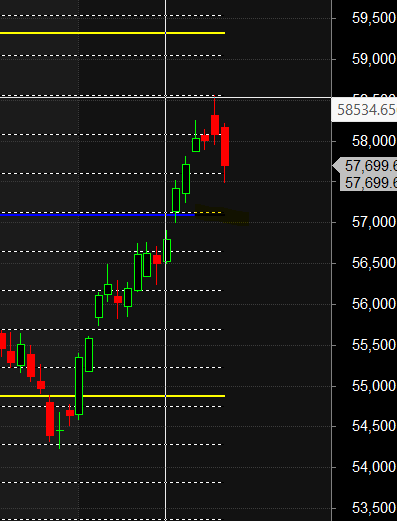
This has established a clear and critical technical trigger for the next wave of selling. The line in the sand for the bears is Friday’s low of 57482.
A decisive break below 57482 will signal that the selling pressure is intensifying and that the bears are in complete control. Such a break is expected to lead to a quick and sharp fall as stop-losses are triggered and fresh shorts are initiated.
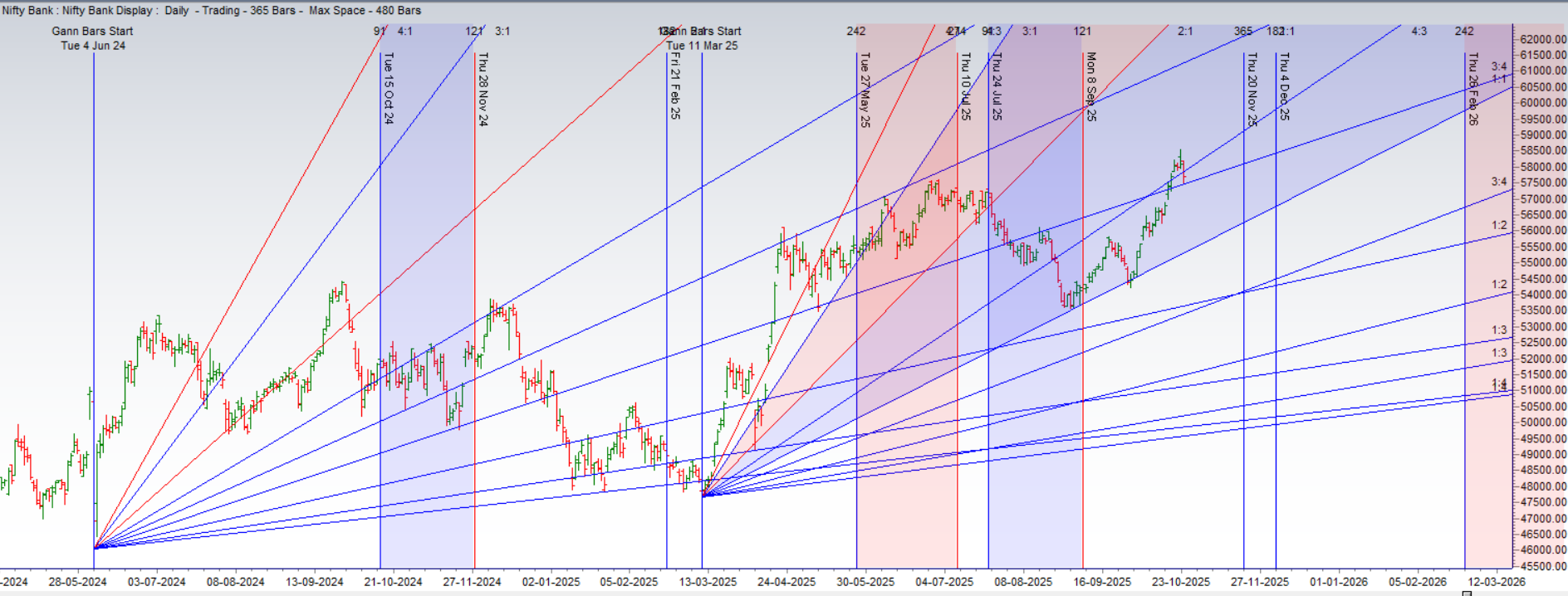
The logical and immediate downside target for this move is the psychologically and technically significant level of 57000, which is an important Gann level.
Conclusion:
The bearish case for the Bank Nifty is now clear, powerful, and multi-faceted. We have a confirmed major timing signal (Bayer Rule 15), confirmed weakness in one heavyweight (HDFC Bank), and a fresh, negative fundamental catalyst for another (Kotak Bank). The risk is now overwhelmingly skewed to the downside. Watch the 57482 level with extreme vigilance. A break below it will be the starting gun for the next powerful decline towards the 57000 Gann support.
Bank Nifty Trade Plan for Positional Trade ,Bulls will get active above 57851 for a move towards 58093/58335. Bears will get active below 57367 for a move towards 57125/5683
Bank Nifty Oct Futures Open Interest Volume stood at 12.8 lakh, with liquidation of 2.3 Lakh contracts. Additionally, the Increase in Cost of Carry implies that there was a closeure of LONG positions today.
Bank Nifty Advance Decline Ratio at 01:11 and Bank Nifty Rollover Cost is @55170 closed above it.
BANK Nifty Gann Monthly Trend Change level 56022 closed above it.
Bank Nifty closed above its 21SMA @57000,Trend is Buy On Dips till above 57000
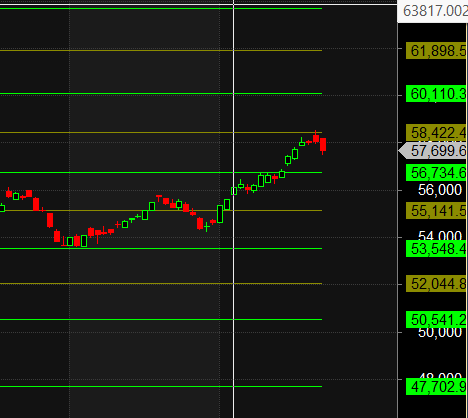
Traders who follow the musical octave trading path may find valuable insights in predicting Bank Nifty’s movements. According to this path, Bank Nifty may follow a path of 53548-55141-56734-58422. This means that traders can take a position and potentially ride the move as Bank Nifty moves through these levels. Of course, it’s important to keep in mind that trading is inherently risky and market movements can be unpredictable.
According to the Bank Nifty options chain, the call side has the highest open interest (OI) at the 58000 strike, followed by the 58300 strike. On the put side, the 57500 strike has the highest OI, followed by the 57000 strike.This indicates that market participants anticipate Bank Nifty to stay within the 57000-58000 range.
The Bank Nifty options chain shows that the maximum pain point is at 57400 and the put-call ratio (PCR) is at 0.83 Typically, when the PCR open interest ranges between 0.90 and 1.05, the market tends to remain range-bound. PCR is on extreme end suggesting we can see sharp reversal .
Successful trading requires a deep understanding of the market, a solid strategy, and, most importantly, a well-prepared http://mindset.it demands concentration, preparation, and an awareness of the psychological challenges that come with it.
For Positional Traders, The Bank Nifty Futures’ Trend Change Level is At 56824. Going Long Or Short Above Or Below This Level Can Help Them Stay On The Same Side As Institutions, With A Higher Risk-reward Ratio. Intraday Traders Can Keep An Eye On 57777, Which Acts As An Intraday Trend Change Level.
Wishing you good health and trading success as always.As always, prioritize your health and trade with caution.
As always, it’s essential to closely monitor market movements and make informed decisions based on a well-thought-out trading plan and risk management strategy. Market conditions can change rapidly, and it’s crucial to be adaptable and cautious in your approach.