


The Indian bond market is broken.
This stark reality has sent shockwaves through the financial ecosystem, leaving banks, institutional investors, and policymakers scrambling for answers. The 10-year Government Security (G-Sec) yield, a critical benchmark for borrowing costs, has surged dramatically, eroding the value of bond portfolios and inflicting heavy losses on banks. In just a few months, the optimism surrounding rate cuts has evaporated, replaced by fears of prolonged monetary tightening and fiscal instability.
The initial shock came when the 10-year G-Sec yield climbed from around 6.13 % to nearly 6.5 %—a seemingly small jump that translates into massive mark-to-market losses for bondholders.
10-year G-Sec yields just skyrocketed to 6.5% – wiping out ₹2 lakh crore from bank portfolios in weeks.
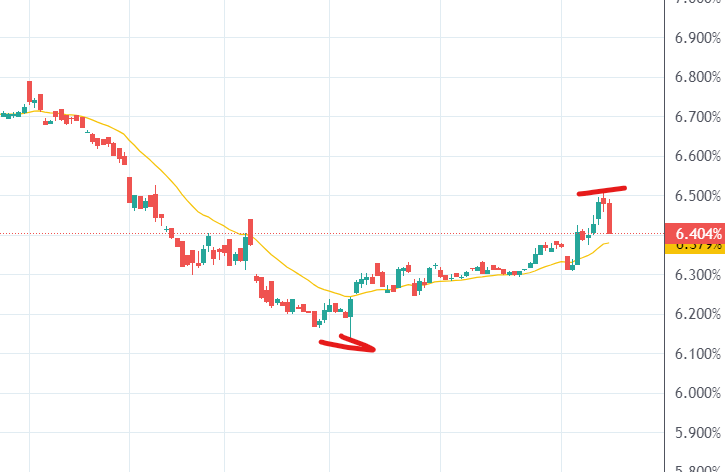
Banks, which hold large quantities of government bonds, saw their treasury books bleed, while mutual funds and insurance companies faced redemption pressures as investors fled fixed-income assets.
But what caused this sudden breakdown in confidence? Why has the bond market, traditionally seen as a stable investment avenue, turned into a battleground of uncertainty?
This article dissects the core reasons behind the bond market’s turmoil—highlighting the twin threats of monetary policy shifts and fiscal slippage—and explores what lies ahead for investors. More importantly, we examine how this bond market crisis could spill over into the stock market, reshaping investment strategies in the coming months.
The Two Pillars of Bearishness: Monetary and Fiscal Fears
Just a few months ago, the market was pricing in multiple rate cuts by the Reserve Bank of India (RBI) in 2025. Inflation was easing, growth appeared stable, and global central banks were signaling a dovish turn. However, that narrative has completely reversed.
The RBI’s recent policy stance has turned hawkish, dashing hopes of near-term rate cuts. Instead of preparing for easing, traders are now bracing for a prolonged pause—or worse, a rate hike. This shift stems from:
-
Global Uncertainty: The U.S. Federal Reserve has delayed its own rate cuts, keeping global yields elevated and limiting the RBI’s room for maneuver.
-
RBI’s Caution due to Trump Tariff
- RBI shifted from “accommodative” to “withdrawal of accommodation”
This abrupt shift has triggered a bond sell-off, as investors demand higher yields to compensate for the increased risk of tighter monetary policy.
The Threat of Fiscal Slippage
While monetary policy fears are significant, the bigger worry is fiscal slippage—the risk that the government may miss its deficit targets.
What Is Fiscal Slippage?
Fiscal slippage occurs when the government’s actual fiscal deficit exceeds its budgeted target, usually due to lower-than-expected revenues or higher spending.
Why Is the Market Worried?
-
Disappointing Tax Collections: GST and corporate tax revenues have fallen short of projections, raising concerns about the government’s ability to meet its fiscal deficit target of 4.4 % of GDP for FY25.
-
Higher Borrowing Needs: If revenues lag, the government may need to borrow more by issuing additional bonds, increasing supply in an already strained market.
-
Tax Collection Shortfall: ₹50,000 crore deficit feared
-
Supply Glut: States + Centre flooding market with bonds
The result? Higher bond yields, as investors demand greater compensation for the risk of increased government borrowing.
Deeper Dive: Supply, Demand, and Market Psychology
The Supply Overload
The bond market is a classic case of supply and demand imbalance.
-
Excessive Issuance: The government has been leaning towards longer-dated bonds (15-year, 30-year) to lock in borrowing costs. However, these bonds are harder to absorb because they carry higher duration risk.
-
Auction Failures: Recent bond auctions have seen weak demand, forcing the RBI to intervene or accept higher yields.
The Absence of Key Buyers
Normally, four major players absorb government bonds:
-
Banks: Traditionally the biggest buyers, but new mark-to-market accounting rules have made them reluctant to hold long-term bonds.
-
Insurance Companies & Pension Funds: Their demand is steady but insufficient to offset the supply surge.
-
Foreign Portfolio Investors (FPIs): Bond outflows have increased due to global yield shifts and India’s inclusion in global bond indices failing to attract expected inflows.
-
Retail Investors: Still a small player in the G-Sec market, despite RBI’s efforts to boost retail participation.
With demand weakening and supply rising, bond prices are falling, pushing yields higher.
The Call for Clarity
Experts argue that the RBI and government need to restore the “expectation channel”—clear communication to guide market sentiment.
-
Better Policy Signals: The RBI could provide more explicit forward guidance on rates.
-
Supply Management: The government could issue more short-term bonds (like Treasury Bills) to ease pressure on long-term yields.
Without these measures, volatility will persist.
How Bond Market Stress Spills Over into Stocks
1. Rising Bond Yields = Higher Borrowing Costs for Companies
When government bond yields rise, corporate borrowing costs follow. Here’s why:
-
Corporate Bonds vs. G-Secs: Companies issue bonds at a spread over government securities. If 10-year G-Sec yields jump from 7% to 7.25%, a top-rated corporate bond that was priced at 7.5% may now need to offer 7.75% or higher to attract investors.
-
Impact on Profit Margins: Higher interest expenses eat into earnings, particularly for debt-heavy sectors like infrastructure, real estate, and telecom.
-
Stock Valuations: If earnings decline due to higher interest costs, price-to-earnings (P/E) multiples may contract, dragging down stock prices.
Sectors Most Affected:
-
Banks & NBFCs: Their cost of funds rises, squeezing net interest margins (NIMs).
-
Capital-Intensive Industries (Cement, Steel, Power): More expensive debt hurts expansion plans.
-
Startups & Growth Stocks: Many rely on cheap debt—higher rates reduce profitability.
2. Foreign Investor Outflows: The Domino Effect
Foreign Portfolio Investors (FPIs) play a major role in both bond and equity markets. When bond yields rise:
-
Global Investors Seek Higher Returns Elsewhere: If U.S. Treasury yields rise while India’s fiscal risks increase, FPIs may pull money out of both bonds and stocks.
-
Index Inclusion Not Enough: Despite India’s inclusion in global bond indices, sustained outflows can hurt sentiment in equities too.
-
Currency Pressure: If FPIs exit, the rupee weakens, making imports costlier and fueling inflation—another negative for stocks.
3. Banks Under Stress: A Double Whammy for Stocks
Banks are the largest holders of government bonds. When bond yields rise:
-
Mark-to-Market (MTM) Losses: Banks must value bonds at current market prices. Rising yields = falling bond prices = losses on their books.
-
Tighter Lending: To compensate for losses, banks may raise loan rates or reduce credit growth, slowing economic activity.
-
Stock Performance: Banking stocks (especially PSU banks) underperform due to treasury losses.
4. Shift in Investor Preference: Bonds vs. Stocks
When bond yields become attractive:
-
Debt Funds Get More Appeal: Retail investors may move money from equity mutual funds to debt funds, reducing stock market liquidity.
-
Dividend Stocks Lose Shine: High-yield bonds compete with dividend-paying stocks (e.g., FMCG, utilities), making them less attractive.
5. Economic Growth Concerns = Lower Equity Valuations
-
Fiscal Tightening Risk: If the government cuts spending to control deficits, GDP growth could slow, hurting corporate earnings.
-
Inflation Fears Persist: Sticky inflation keeps RBI hawkish, delaying rate cuts that could boost equities.
Stock Market Impact:
-
Large-Caps More Resilient: Blue chips (Reliance, HDFC Bank) may hold up better.
-
Mid & Small-Caps Vulnerable: Higher borrowing costs hit them harder.
What Should Stock Investors Do Now?
1. Watch Key Triggers
-
RBI Policy Statements: Any hint of rate hikes will spook stocks.
-
Fiscal Deficit Data: Higher borrowing = more bond supply = pressure on yields.
-
FPI Flows: Sustained outflows could deepen market corrections.
2. Sectoral Strategies
-
Avoid Highly Leveraged Firms: Focus on companies with strong cash flows.
-
Defensive Stocks (IT, Pharma): May outperform if growth slows.
-
Banking Stocks: Wait for clarity on bond losses before buying.
3. Long-Term Play: Bonds vs. Stocks?
-
If Yields Peak (7.5%+), Bonds Become Attractive: Locking in high yields may be wise.
-
Equities for Growth: If RBI eventually cuts rates, stocks could rebound sharply.
Conclusion: Navigating the Storm
The bond market’s breakdown is sending shockwaves through equities. Rising yields hurt corporate profits, trigger foreign outflows, and strain banks—all of which weigh on stock prices. While short-term pain is likely, long-term investors should stay selective, focusing on sectors with low debt and strong fundamentals.
The key takeaway? Bond market turmoil doesn’t stay confined—it spills into stocks. Understanding this link can help you make smarter investment decisions in these uncertain times.
Final Thought
The bond market’s turmoil is not an isolated event—it’s a warning sign for the broader economy. Investors must stay vigilant, diversify portfolios, and prepare for continued volatility. The road ahead is uncertain, but understanding these dynamics is key to navigating the storm.
extremely detailed analysis bramesh ji
great…but chakkar atha hai!!! ye sab dhekkar
have a great day
warm regards