A Classic Bull Trap: FIIs’ Massive Buying in Bank Nifty is Purely Short Covering
On the surface, the trading session of October 1st, 2025, appeared to be a day of immense bullish conviction from institutional players. The data showed Foreign Institutional Investors (FIIs) engaging in massive net buying in the Bank Nifty Index Futures, acquiring 3,540 contracts with a hefty notional value of ₹685 crores. A buying figure of this magnitude would, under normal circumstances, be an unequivocally bullish signal, suggesting the “smart money” is aggressively building positions for a sustained up-move.
However, this bullish interpretation is completely invalidated by the session’s most critical data point: the net open interest (OI) decreased by 710 contracts. This is the irrefutable signature of a large-scale short-covering operation, not genuine bullish buying.
Decoding the Real Motivation
The relationship between price, volume, and open interest is paramount to understanding the market’s true intentions. Here’s what happened:
The powerful buying that drove the Bank Nifty higher was not the result of FIIs initiating new long positions. Instead, it was the mechanical, and likely forced, buying required for them to close out their existing short (bearish) positions. When a trader covers a short, they must buy back the contracts they previously sold. This action fuels an upward price move but, because it closes an existing trade, it reduces the total number of open contracts in the market, causing the OI to fall.
This was not a strategic shift to a bullish view; it was a tactical retreat to lock in profits on successful bearish bets.
Key Implications for Traders:
A Hollow and Fragile Up-Move: A price advance built on short covering is inherently fragile. It lacks the foundation of new, optimistic capital. Such moves can be sharp and swift, but they are often unsustainable and highly prone to reversal once the short-covering impulse has been exhausted.
The Perfect Bull Trap: This scenario is a classic bull trap in action. Retail traders, seeing the price surge and the massive net buying figure, can be easily lured into chasing the move. They risk buying at elevated levels, providing the very exit liquidity that the institutional players need to close out their short positions profitably.
Institutional Sentiment Has Not Turned Bullish: This action does not mean that FIIs are now optimistic about the banking sector. It is a profit-taking maneuver. The underlying reasons for their initial bearishness may still be fully intact. It is highly probable that they will view this price surge as an opportunity to re-initiate new short positions at more favorable, elevated levels.
Conclusion:
Traders must not be deceived by the headline buying figure. The FII activity in the Bank Nifty on October 1st was not a signal of renewed optimism but a massive, technically-driven short-covering event. The decrease in open interest is the definitive evidence. The prudent approach is to treat this upward price move with extreme skepticism and to recognize that the institutional sentiment has not necessarily turned bullish. Any long positions taken on the back of this move carry an exceptionally high risk of a sharp reversal.
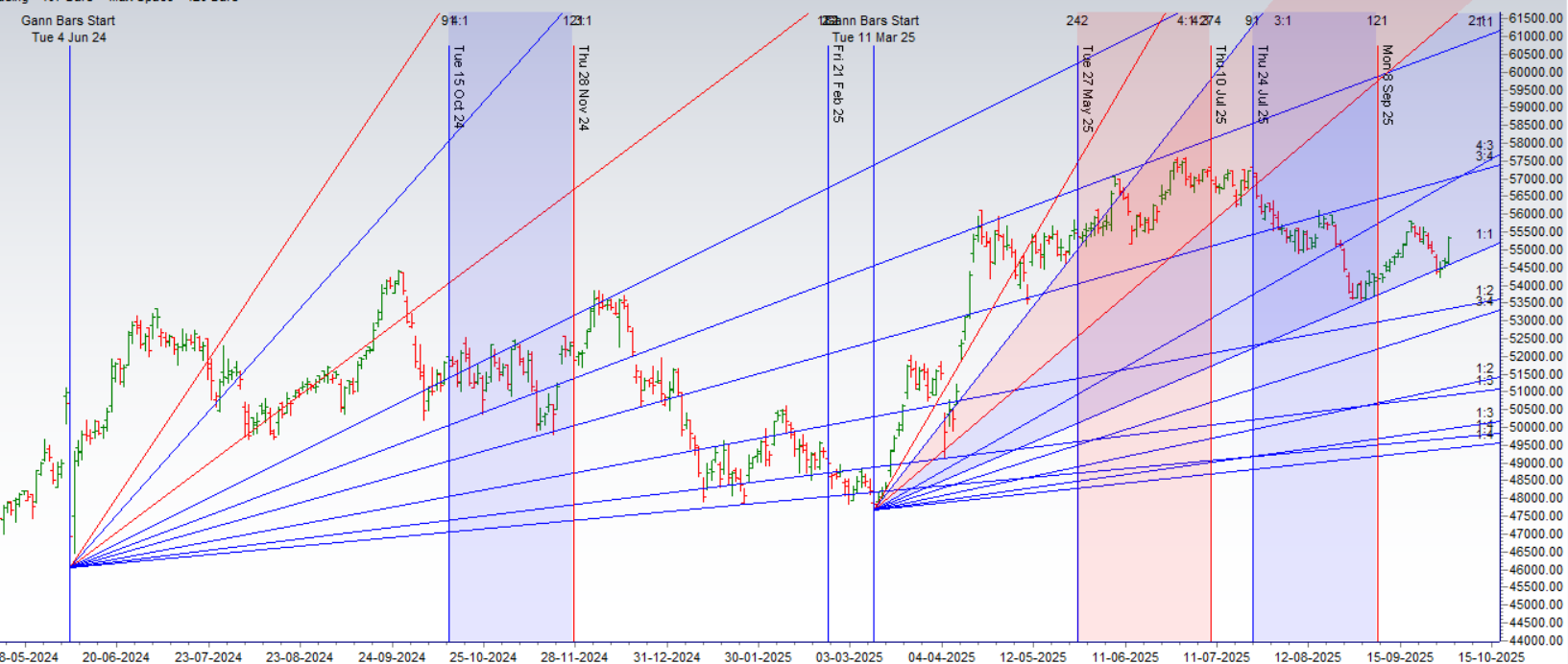
The Bank Nifty delivered a masterclass in technical precision and news-driven volatility today, providing a powerful reminder of how key support levels and unexpected policy announcements can shape the market’s direction. In a classic and powerful display, the index bounced perfectly from a critical Gann support level, igniting a fierce rally fueled by surprise reforms from the Reserve Bank of India.
The Technical Anchor: The 1×1 Gann Angle Holds Supreme
Before any news hit the wires, the market’s technical structure was already at a critical juncture. The Bank Nifty was declining towards its key 1×1 Gann Angle, a historically significant trendline that provides dynamic support.
This is the very same angle that halted the decline and initiated a powerful bounce on September 25th. The fact that the index has once again found precise and unwavering support at this exact technical confluence is a testament to the power of Gann analysis. This was not a random bounce; it was a textbook defense of a pre-defined and respected support level. For Gann traders, this provided the first and most important signal that the selling pressure was exhausting and a reversal was probable.
The Catalyst: RBI Surprise Unleashes a Short Squeeze
While the market was expecting the RBI to keep the repo rate steady at 5.50%, the real catalyst came from an unexpected announcement. The RBI’s unveiling of “big bang banking reforms,” including a hike in the limit for loans against shares, acted as a powerful positive surprise for the financial sector.
This unexpected good news landed on a market that was technically oversold in the short term and had significant short positions built up. The result was not just a simple rally; it was a classic and aggressive short-covering rally. Traders who were betting on a breakdown below the Gann angle were caught off-guard and forced to buy back their short positions to limit their losses. This forced buying created a vacuum, pulling the price sharply higher and amplifying the bullish momentum.
The Weekly Closing Battleground: Bulls vs. Bears
This entire sequence of events now sets the stage for a critical battle as we head into the weekly close. The day’s rally has been impressive, but the closing print is what truly matters for setting the tone for next week. Both bulls and bears have clear and well-defined objectives:
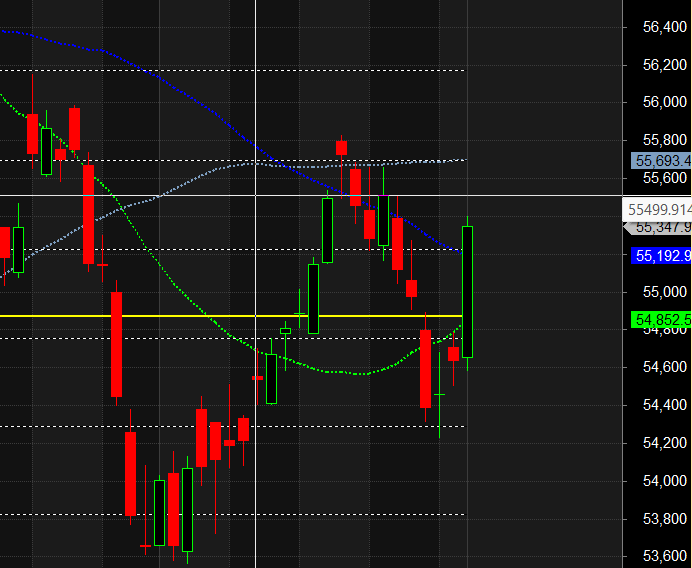
The Bulls’ Objective: The bulls will fight to secure a weekly close within the key range of 55595 – 55620. A close in this zone would be a major victory. It would not only validate the reversal from the Gann angle but would also close the week on a note of strength, suggesting that the rally has enough power to continue into the next sessions.
The Bears’ Objective: The bears, on the other hand, will aim to push the price back down and secure a close below 55100. A close below this level would be a significant bearish victory. It would invalidate the day’s rally, framing it as a mere temporary, news-driven “head fake” and signaling that the broader downtrend remains firmly in control.
Conclusion:
The market is now in a classic tug-of-war. The technical defense of the Gann angle and the positive news from the RBI have given the bulls a powerful weapon. However, the bears will not cede control of the weekly trend without a fight. The closing price today will be the ultimate arbiter of this battle. Watch the ranges of 55595-55620 and 55100 closely, as they will likely dictate the market’s next significant move.
Bank Nifty Trade Plan for Positional Trade ,Bulls will get active above 55390 for a move towards 55623/55856. Bears will get active below 55158 for a move towards 54925/54692
Bank Nifty Oct Futures Open Interest Volume stood at 18.8 lakh, with addition of 1.1 Lakh contracts. Additionally, the Increase in Cost of Carry implies that there was a addition of LONG positions today.
Bank Nifty Advance Decline Ratio at 08:04 and Bank Nifty Rollover Cost is @55170 closed above it.
BANK Nifty Gann Monthly Trend Change level 54422 closed above it.
Bank Nifty closed above its 21SMA @55192 ,Trend is Buy On Dips till above 55108
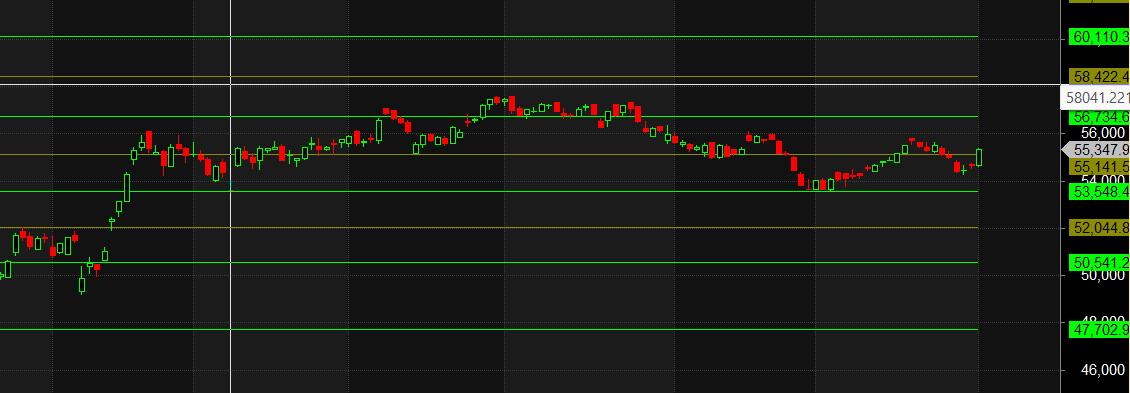
Traders who follow the musical octave trading path may find valuable insights in predicting Bank Nifty’s movements. According to this path, Bank Nifty may follow a path of 53548-55141-56734-58422. This means that traders can take a position and potentially ride the move as Bank Nifty moves through these levels. Of course, it’s important to keep in mind that trading is inherently risky and market movements can be unpredictable.
According to the Bank Nifty options chain, the call side has the highest open interest (OI) at the 55500 strike, followed by the 56000 strike. On the put side, the 55000 strike has the highest OI, followed by the 54500 strike.This indicates that market participants anticipate Bank Nifty to stay within the 55000-56500 range.
The Bank Nifty options chain shows that the maximum pain point is at 55000 and the put-call ratio (PCR) is at 1.02 Typically, when the PCR open interest ranges between 0.90 and 1.05, the market tends to remain range-bound. PCR is on extreme end suggesting we can see sharp reversal .
Successful trading requires a deep understanding of the market, a solid strategy, and, most importantly, a well-prepared http://mindset.it demands concentration, preparation, and an awareness of the psychological challenges that come with it.
For Positional Traders, The Bank Nifty Futures’ Trend Change Level is At 55223. Going Long Or Short Above Or Below This Level Can Help Them Stay On The Same Side As Institutions, With A Higher Risk-reward Ratio. Intraday Traders Can Keep An Eye On 55410 , Which Acts As An Intraday Trend Change Level.
Wishing you good health and trading success as always.As always, prioritize your health and trade with caution.
As always, it’s essential to closely monitor market movements and make informed decisions based on a well-thought-out trading plan and risk management strategy. Market conditions can change rapidly, and it’s crucial to be adaptable and cautious in your approach.