FIIs’ Buying Frenzy in Bank Nifty: A Textbook Case of Short Covering, Not Bullish Conviction
On the surface, the data from the Bank Nifty Index Futures on September 18, 2025, painted a picture of unbridled bullishness. Foreign Institutional Investors (FIIs) were aggressive net buyers, acquiring 2,441 contracts with a massive notional value of ₹477 crores. An institutional buying figure of this magnitude would typically signal a powerful shift in sentiment and the start of a sustainable upward move.
However, this bullish facade is completely dismantled by the session’s most crucial data point: the net open interest (OI) plummeted by a staggering 3,029 contracts. This stark contradiction between heavy buying and a sharp decline in open interest is the unequivocal and textbook signature of a massive short-covering event.
Unmasking the True Motivation
The buying that propelled the Bank Nifty was not driven by new, optimistic capital entering the market. Instead, it was the mechanical, and likely forced, buying from FIIs who were closing out their existing bearish (short) positions. When a trader covers a short, they must buy back the contracts they previously sold. This action creates upward pressure on the price, but because it closes an existing trade, it reduces the total number of open contracts in the market, leading to a fall in OI.
The fact that the OI decrease (-3,029) was significantly larger than the net buying figure (+2,441) provides definitive proof that the overwhelming activity of the day was the closing of short positions. The FIIs were cashing in their winning bearish bets, not placing new bullish ones.
Key Implications for Traders:
A Structurally Weak Upthrust: The day’s price advance is not built on a foundation of new bullish conviction. It is built on the unstable ground of bears exiting the market. Such technically-driven moves are often sharp and violent but are inherently fragile and highly susceptible to reversal once the short-covering impulse has been exhausted.
Profit-Taking, Not a Change in Sentiment: This action should not be misinterpreted as the FIIs turning bullish on the banking sector. It is a tactical maneuver to lock in profits. The underlying reasons for their initial bearishness may still be fully intact, and they may well view this price surge as an opportunity to re-initiate new short positions at more favorable, elevated levels.
The Classic Bull Trap: This scenario is one of the most effective ways that retail traders get trapped. Seeing the price surge and the massive FII buying figure, they may be lured into buying, believing a new sustainable trend has begun. In reality, they are providing the very exit liquidity that the institutional players need to close their positions profitably.
Conclusion:
Traders must look past the deceptive headline buying figure and focus on the irrefutable evidence from the open interest data. The powerful upward move in the Bank Nifty on September 18th was not a signal of renewed optimism but a massive, technically-driven short-covering event. The prudent approach is to treat this price advance with extreme skepticism and to recognize that the institutional sentiment has not necessarily turned bullish.
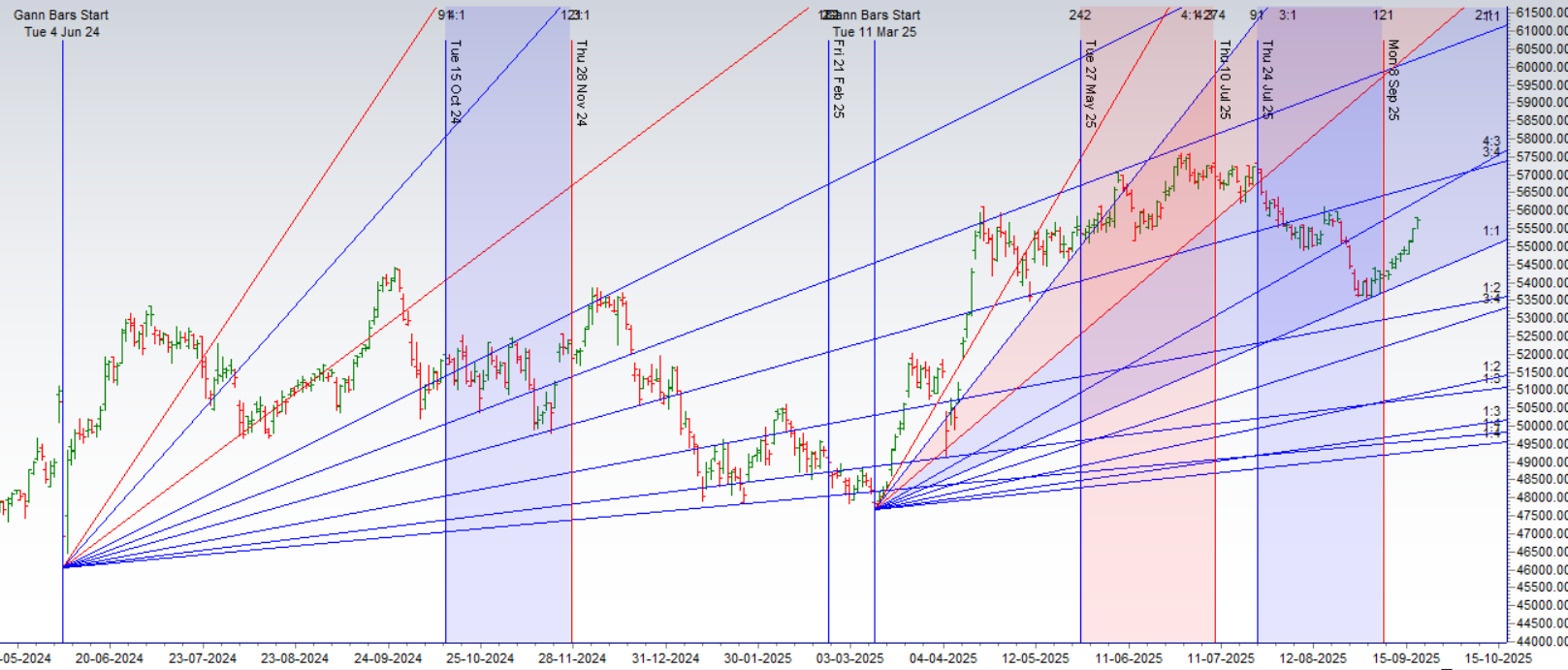
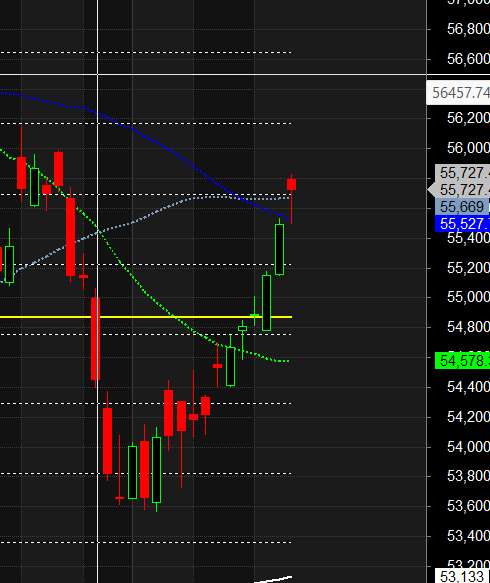
The Bank Nifty demonstrated significant bullish conviction in today’s session, continuing its powerful rally to achieve a crucial technical milestone. The index secured a decisive close above the 55595 level, a key Gann Octave point that had previously acted as a formidable resistance. This is a classic technical development where a ceiling of supply has now been converted into a solid floor of support, placing the bulls firmly in control of the short-term trend.
With this major hurdle cleared, the path is now open for a potential ascent towards the next significant resistance zone, which lies between 56103 and 56200. This area is particularly important as it represents a confluence of Gann Angle resistance, a point where price and time are expected to meet, creating a natural point for the trend to pause or potentially reverse. As long as the bulls can successfully defend the 55595 support level on any pullbacks, this upper target remains the logical objective.
Adding a layer of intrigue and specific focus to tomorrow’s session is a key astrological event: a Venus Ingress. In financial astrology, Venus governs value, harmony, and the banking sector. An ingress, where a planet changes signs, often coincides with a palpable shift in sentiment and price trends for the assets it rules. Critically, this event is expected to have a notable impact on the two heavyweights of the banking index: HDFC Bank and ICICI Bank. The performance of these two stocks will be on the radar tomorrow and could be the primary driver of the Bank Nifty’s direction.
For traders navigating what promises to be an eventful session, a clear and effective intraday strategy has emerged. The intense directional momentum will be best captured by closely watching the high and low of the first 15 minutes of trading:
A breakout above the 15-minute high would signal a continuation of the powerful upward momentum, likely targeting the 56103/56200 zone.
A breakdown below the 15-minute low would indicate that the Venus Ingress is bringing about a negative shift in sentiment, potentially triggering a reversal to re-test the key support at 55595.
In conclusion, while the price action is strongly bullish, the influence of the Venus Ingress on key banking stocks introduces a significant variable. The opening range tomorrow will be the ultimate guide, providing the crucial confirmation of whether the bullish momentum will continue or if a sentiment shift is about to take hold.
Bank Nifty Trade Plan for Positional Trade ,Bulls will get active above 55801 for a move towards 56035/56268. Bears will get active below 55568 for a move towards 55335/55102
Bank Nifty August Futures Open Interest Volume stood at 20.3 lakh, with liqudiation of 1.6 Lakh contracts. Additionally, the Increase in Cost of Carry implies that there was a covering of SHORT positions today.
Bank Nifty Advance Decline Ratio at 06:06 and Bank Nifty Rollover Cost is @55309 closed below it.
BANK Nifty Gann Monthly Trend Change level 54666 closed above it.
Bank Nifty closed above its 21SMA @55527 ,Trend is Buy on Dips till above 55555
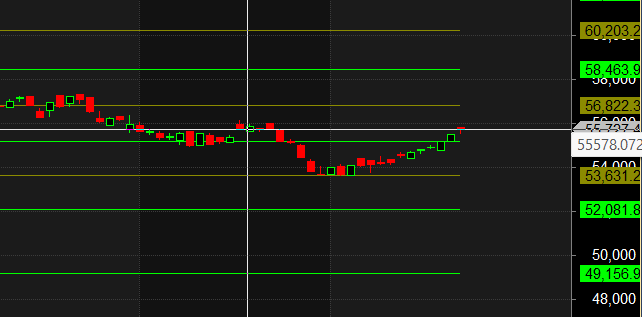
Traders who follow the musical octave trading path may find valuable insights in predicting Bank Nifty’s movements. According to this path, Bank Nifty may follow a path of 53548-55141-56734-58422. This means that traders can take a position and potentially ride the move as Bank Nifty moves through these levels. Of course, it’s important to keep in mind that trading is inherently risky and market movements can be unpredictable.
According to the Bank Nifty options chain, the call side has the highest open interest (OI) at the 56000 strike, followed by the 56500 strike. On the put side, the 55500 strike has the highest OI, followed by the 55000 strike.This indicates that market participants anticipate Bank Nifty to stay within the 54500-55500 range.
The Bank Nifty options chain shows that the maximum pain point is at 55500 and the put-call ratio (PCR) is at 1.10 Typically, when the PCR open interest ranges between 0.90 and 1.05, the market tends to remain range-bound. PCR is on extreme end suggesting we can see sharp reversal .
Successful trading requires a deep understanding of the market, a solid strategy, and, most importantly, a well-prepared http://mindset.it demands concentration, preparation, and an awareness of the psychological challenges that come with it.
For Positional Traders, The Bank Nifty Futures’ Trend Change Level is At 54722 Going Long Or Short Above Or Below This Level Can Help Them Stay On The Same Side As Institutions, With A Higher Risk-reward Ratio. Intraday Traders Can Keep An Eye On 55852, Which Acts As An Intraday Trend Change Level.
Wishing you good health and trading success as always.As always, prioritize your health and trade with caution.
As always, it’s essential to closely monitor market movements and make informed decisions based on a well-thought-out trading plan and risk management strategy. Market conditions can change rapidly, and it’s crucial to be adaptable and cautious in your approach.