The Slow Squeeze: FIIs Maintain Bearish Grip on Bank Nifty with High-Conviction Shorts
In a market accustomed to explosive, headline-grabbing moves, it’s often the quiet, persistent pressure that proves most significant. Today, in the Bank Nifty Index Futures market, we witnessed a masterclass in this slow, grinding pressure from the Foreign Institutional Investors (FIIs).
While the numbers may seem modest at first glance—a net shorting of 379 contracts worth ₹74 crore—the underlying details reveal a continuation of the powerful bearish thesis that has been building for days. This is not the shock and awe of a thousand-crore onslaught; this is the slow, methodical squeeze of a python, tightening its grip on the market’s most critical sector.
The real story, as always, lies not in the net figures, but in the subtle yet powerful signal sent by the increase in Open Interest. This confirms that the “smart money” is not backing down; they are quietly adding to their bearish conviction.
Decoding the Data: Quality over Quantity
Let’s break down the three key components of today’s FII activity to understand why this seemingly small move carries such significant weight.
The Position: FIIs were net sellers, shorting 379 contracts of Bank Nifty futures. In a vacuum, this number is small. But in the context of their already massive short position, it signifies a clear intent to maintain and add to their bearish stance. They are not covering; they are pressing their advantage.
The Capital Deployed: The value of these new short positions was ₹74 crore. While not a blockbuster number, it is still a substantial allocation of fresh capital. It reinforces that their bearish view is not just a passive stance but an active, funded strategy.
The Decisive Clue: The Increase in Open Interest: This is where the story gets its power. The FIIs’ shorting activity resulted in a net open interest (OI) increase of 115 contracts.
Open Interest: The Unmistakable Sign of Fresh Bearish Bets
Open Interest (OI) is the ultimate arbiter of market conviction. It tells us whether new money is entering the market or old money is leaving.
When OI decreases, it means traders are closing out old positions.
When OI increases, it means traders are creating new positions with fresh capital.
The fact that Open Interest increased on a day of net shorting by FIIs is the critical piece of the puzzle. It proves that this was not a simple shuffling of positions. The FIIs’ primary action was the creation of brand new bearish positions.
Even though the net OI increase of 115 contracts is small, it is directionally aligned with the FIIs’ shorting. This confirms that the new money entering the Bank Nifty futures market today was predominantly on the short side, driven by institutional conviction. They are not just holding onto their winning bearish bets; they are methodically adding to them, drip by drip.
The Strategy: A Grinding Pressure Campaign
Think of this in strategic terms. A massive, thousand-crore shorting day is like an artillery barrage—it’s meant to shock the market and force a breakout. Today’s action is different. It’s like a sniper taking a carefully aimed shot.
This kind of persistent, smaller-scale shorting accompanied by an OI increase signifies a few key things:
No Capitulation: The FIIs are not seeing any reason to abandon their bearish thesis. The underlying macro or sector-specific concerns that led them to build their massive short position remain firmly in place.
Absorbing Bullish Attempts: This selling likely occurred into any intraday bounces, effectively capping any rally attempts. It is a way to methodically absorb the buying pressure from retail and other players, preventing the market from gaining any upward momentum.
Building a Stronger Position: By adding to their shorts at different price levels, FIIs are improving their average entry price and building an even more formidable bearish position that will be harder to dislodge.
Implications for Traders: The Bearish Grip Tightens
This data is a powerful confirmation that the bearish pressure on the banking sector is not a one-day event; it is a sustained campaign.
The “Smart Money” is Not Backing Down: The FIIs are continuing to press their bets against the Bank Nifty. The bearish trend remains firmly intact from an institutional flow perspective.
Rallies are Likely to be Sold: The nature of this activity suggests that any intraday or short-term rally will be met with institutional selling pressure, making it difficult for the bulls to gain any meaningful traction.
The Risk of a Sharp Decline Remains High: While today’s action was a slow grind, the massive underlying short position built over previous sessions is still a powder keg. This persistent selling is tightening the coil, and any negative catalyst could still trigger the sharp, cascading decline that the FIIs are positioned for.
Conclusion:
Do not be fooled by the small headline numbers. Today’s FII activity in the Bank Nifty was a significant and telling event. It demonstrated a persistent, methodical, and high-conviction bearish stance. The increase in open interest, however small, confirms that new money continues to flow to the short side of the market.
The institutional pythons are not just holding their grip on the banking sector; they are slowly tightening it. For traders, the message is clear: the path of least resistance remains to the downside, and any rally should be viewed with extreme suspicion until the “smart money” shows a definitive sign of changing its tune.
A flicker of bullish hope at the market open was brutally extinguished today, as the Bank Nifty gapped up only to be met by a wave of determined selling. This classic “failed rally” has left the market at a critical crossroads, with the bulls now facing a formidable fortress of resistance. The period of uncertainty following the major bank earnings is over; the market is now making up its mind, and the initial verdict looks grim for the bulls.
This isn’t just a simple technical rejection. The current price action is unfolding against a complex and dangerous backdrop: a major heavyweight from a rival sector (Infosys) is set to report earnings, and the institutional “smart money” (FIIs) continues to build a massive bearish position in the background.
The battle lines are now clearly drawn. A very specific and critical price zone will likely determine the fate of the Bank Nifty for the coming days.
The Failed Rally: A Classic Sign of Weakness
Today’s price action was a textbook example of a bearish “gap-and-go”… in reverse. The gap-up at the open represented early morning optimism, a sign that buyers were willing to pay higher prices. However, their inability to sustain this momentum and the subsequent sell-off is a powerful bearish signal.
It indicates that:
Supply is overwhelming demand at higher levels. Sellers are aggressively using any strength as an opportunity to offload their positions or initiate new shorts.
Buyer conviction is weak. The initial burst of buying lacked the follow-through needed to push the market higher, suggesting the bulls are exhausted or hesitant.
This failed rally has pushed the Bank Nifty directly into a critical wall of technical resistance, which now becomes the central battleground.
The Fortress of Resistance: The 57091 – 57210 Zone
The bulls’ path forward is now blocked by a narrow but powerful zone of resistance that is defined by two distinct and significant technical levels:
The SAP Level at 57091: This proprietary Systematic Analytical Point acts as a key pivot. For the bulls, it is the first major hurdle they must overcome to prove their strength.
The Gann Monthly TC Level at 57210: This level, derived from W.D. Gann’s complex time and price analysis, represents a major monthly point of resistance. Such levels are historically very difficult to breach on the first attempt.
This 57091-57210 range is now the ultimate line in the sand. It is a confluence of resistance that acts as a powerful ceiling. The market’s inability to close above this zone is a clear sign that the bears are in control. As long as the Bank Nifty remains below this fortress, the path of least resistance is to the downside.
The Sector Rotation Wildcard: All Eyes on Infosys
Adding a fascinating and dangerous twist to this setup is an event from outside the banking sector: the Infosys results. While it may seem counterintuitive, a strong performance from the IT heavyweight could be decidedly negative for the Bank Nifty.
This is due to the principle of sector rotation. Capital in the market is like water; it flows to where the growth and perceived safety are.
If Infosys delivers a strong earnings surprise, it makes the entire IT sector look more attractive. Large funds may begin to rotate their capital out of the banking sector (where the news is now known and priced in) and into the IT sector to chase the new momentum.
This outflow of capital would put direct selling pressure on Bank Nifty heavyweights, validating the technical resistance and potentially accelerating a decline.
In this context, good news for Infosys could ironically be the bearish catalyst that Bank Nifty traders are dreading.
The Looming Shadow: FIIs’ Massive Bearish Bets
This entire bearish technical and inter-market picture is validated by the most powerful underlying trend: the positioning of the Foreign Institutional Investors. As we have been tracking, FIIs have been relentlessly building a massive short position in the index futures.
This is the dark cloud on the horizon that cannot be ignored. The intraday selling pressure and the failure at resistance are not happening in a vacuum. They are perfectly aligned with the broader strategic positioning of the “smart money.” The FIIs’ short positions provide the dry powder, the fuel for a potential sharp decline if the technical resistance holds and a negative catalyst (like a sector rotation) emerges.
Conclusion: A Clear and Actionable Plan
The market has given us a crystal-clear setup. The battle for the Bank Nifty will be fought and won at the 57091-57210 resistance zone.
The Bearish Case (Higher Probability): As long as the Bank Nifty remains below this zone, the bears are in complete control. The combination of the failed rally, the strong resistance, the looming threat of a sector rotation post-Infosys results, and the massive FII short position creates a powerful argument for a decline towards lower levels.
The Bullish Case (Lower Probability): For the bulls to have any hope, they must do more than just halt the decline. They must mount a powerful counter-attack and achieve a decisive close above 57210. A close above this level would trap the bears and could trigger a sharp short-covering rally, but the odds appear to be stacked against them for now.
Traders must now watch this critical resistance zone with laser focus. The market’s next major directional move will likely be born from the outcome of this pivotal battle.
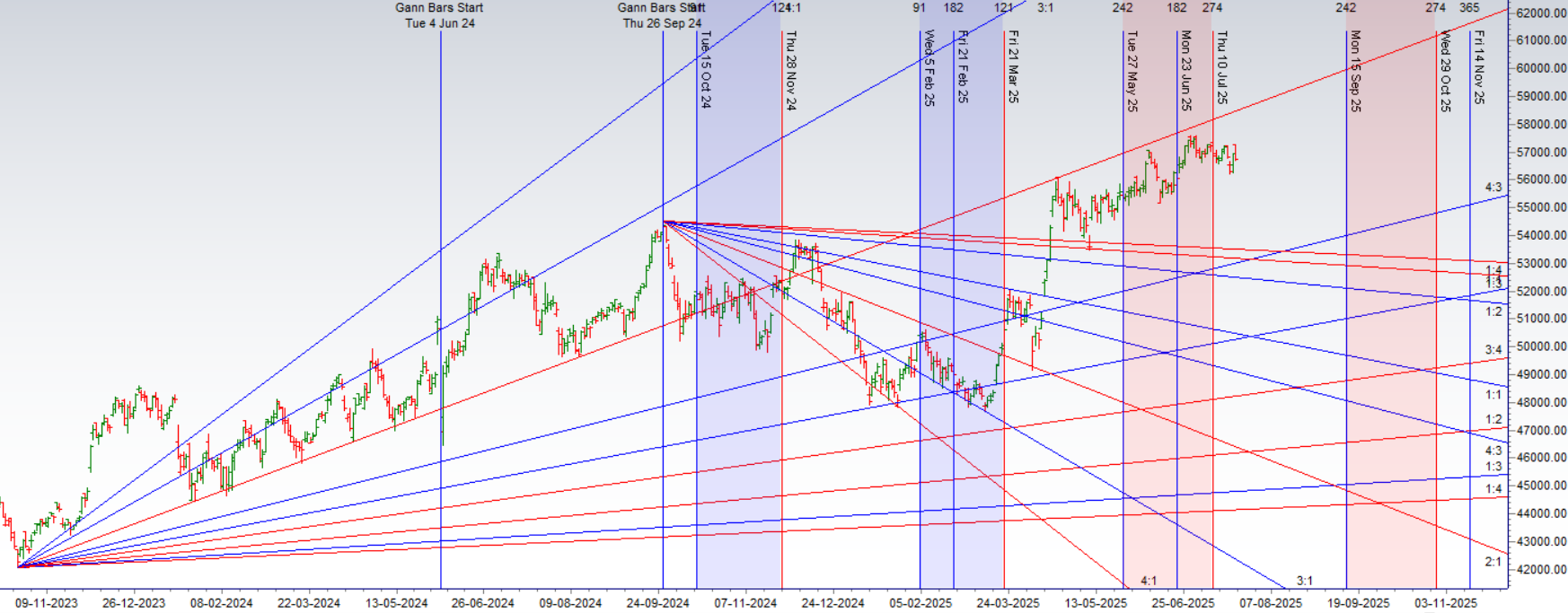
Bank Nifty Trade Plan for Positional Trade ,Bulls will get active above 56916 for a move towards 57153/57390/57627. Bears will get active below 55679 for a move towards 56441/56204
Bank Nifty July Futures Open Interest Volume stood at 20.2 lakh, with liquidation of 0.26 lakh contracts. Additionally, the Increase in Cost of Carry implies that there was a additon of SHORT positions today.
Bank Nifty Advance Decline Ratio at 02:10 and Bank Nifty Rollover Cost is @56875 closed above it.
BANK Nifty Gann Monthly Buy Level : 57730
BANK Nifty Gann Monthly Sell Level : 57021
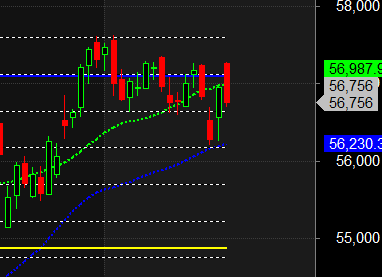
Bank Nifty closed Below its 20 SMA @56987 ,Trend is Sell on Rise till above 57000
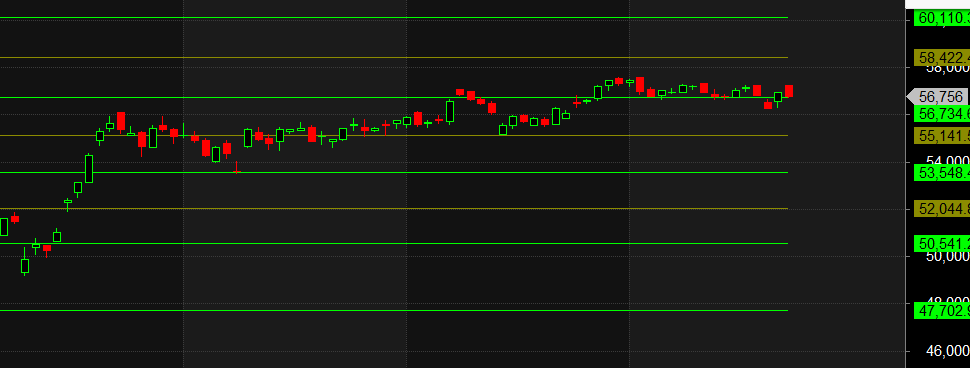
Traders who follow the musical octave trading path may find valuable insights in predicting Bank Nifty’s movements. According to this path, Bank Nifty may follow a path of 53548-55141-56734-58422. This means that traders can take a position and potentially ride the move as Bank Nifty moves through these levels. Of course, it’s important to keep in mind that trading is inherently risky and market movements can be unpredictable.
According to the Bank Nifty options chain, the call side has the highest open interest (OI) at the 57000 strike, followed by the 57500 strike. On the put side, the 56500 strike has the highest OI, followed by the 56000 strike.This indicates that market participants anticipate Bank Nifty to stay within the 56000-57000 range.
The Bank Nifty options chain shows that the maximum pain point is at 56900 and the put-call ratio (PCR) is at 0.74 Typically, when the PCR open interest ranges between 0.90 and 1.05, the market tends to remain range-bound. PCR is on extreme end suggesting we can see sharp reversal .
Don’t trade on emotion. Trading is a numbers game, and it’s important to make decisions based on logic and analysis, not emotion.
For Positional Traders, The Bank Nifty Futures’ Trend Change Level is At 57113 . Going Long Or Short Above Or Below This Level Can Help Them Stay On The Same Side As Institutions, With A Higher Risk-reward Ratio. Intraday Traders Can Keep An Eye On 56961, Which Acts As An Intraday Trend Change Level.
Wishing you good health and trading success as always.As always, prioritize your health and trade with caution.
As always, it’s essential to closely monitor market movements and make informed decisions based on a well-thought-out trading plan and risk management strategy. Market conditions can change rapidly, and it’s crucial to be adaptable and cautious in your approach.