


The Indian equity market has delivered an exceptional performance in the November 2026 derivatives series, with Nifty gaining 11.4% — its strongest monthly series performance since April 2020. Bank Nifty outperformed further, posting a 15% gain, its biggest series advance since February 2021.
What makes this performance particularly interesting is the significant change in institutional positioning. Foreign Institutional Investors (FIIs) have substantially increased their long exposure in index futures, while their cash-market buying has reached unprecedented levels. At the same time, retail and other clients have trimmed their long positions.
As the December 2026 series begins, historical seasonality, institutional positioning and several important global and domestic events will determine the next direction of the Indian equity market.
Let’s examine the important data points and what they could mean for Nifty and Bank Nifty in December.
1. November 2026: An Exceptional Month for Indian Equities
November has turned out to be one of the strongest months for Indian equities in recent years.
Here are the key numbers:
| Index / Indicator | November 2026 Performance |
|---|---|
| Nifty | +11.4% |
| Bank Nifty | +15.0% |
| FII Cash Market Buying | ₹1.17 lakh crore |
| Nifty Rollover | 75.5% |
Nifty’s 11.4% gain is its strongest series performance since April 2020, when the index advanced 14.1%.
Bank Nifty has performed even better, recording its biggest series gain since February 2021.
Nifty’s Biggest Series Gains
| Series | Nifty Gain |
|---|---|
| April 2020 | +14.1% |
| November 2026 | +11.4% |
| November 2020 | +11.3% |
| December 2023 | +8.2% |
The November performance indicates strong buying participation across the market. However, after such a substantial monthly advance, December will be important in determining whether the market can sustain its upward momentum.
2. FIIs Record Their Highest Monthly Cash Buying
One of the most significant developments in November has been the return of aggressive FII buying.
According to the NSE figures cited in the source data, FIIs have purchased approximately ₹1.17 lakh crore in the cash market during November so far.
This is being reported as the highest monthly FII buying figure on record.
Such substantial institutional participation is an important development because foreign investor flows can influence market liquidity, sentiment and positioning.
The question now is whether this buying momentum continues into December.
If FII inflows remain strong, they could provide support to the broader market. However, any meaningful reversal in institutional flows needs to be monitored closely.
3. FII Index Futures Positioning: Long Exposure Rises to 20.1%
The derivatives positioning data provides another important insight into the December series.
FII long exposure in index futures has increased considerably.
Percentage of long exposure at the start of each series, as reported in the supplied data.
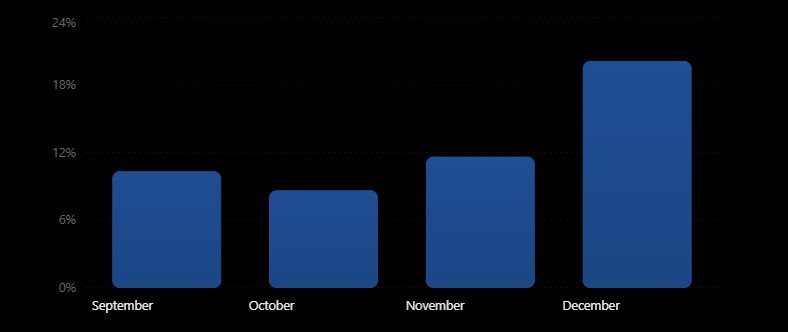
| Series | FII Long Exposure |
|---|---|
| September | 10.3% |
| October | 8.6% |
| November | 11.6% |
| December | 20.1% |
Three important observations emerge:
-
FII long exposure has increased to 20.1%.
-
This is the highest FII long exposure at the beginning of a series since July 2025.
-
Despite the increase, FIIs remain marginally net short, with net exposure of approximately -0.9 lakh contracts.
This is an interesting development. FIIs have significantly improved their positioning, although their overall net exposure has not yet turned positive.
What does this indicate?
The increase in long exposure suggests improved institutional participation on the bullish side. However, the negative net exposure means traders should continue monitoring changes in futures positioning rather than assuming that institutional sentiment has completely shifted.
4. Clients Trim Their Long Positions
Another important development is the reduction in client long exposure.
| Participant Category | Long Exposure |
|---|---|
| Clients – December | 70.2% |
| Clients – Previous Month | 81.4% |
Client long exposure has declined from 81.4% to 70.2%.
This represents a meaningful reduction in bullish positioning among clients.
When combined with the increase in FII long exposure, the positioning data suggests a change in the composition of market participation.
FIIs are increasing their long exposure, while clients have reduced theirs.
This divergence deserves attention as the December series progresses.
5. December Seasonality: Historically a Positive Month for Nifty
December has traditionally been a reasonably favourable month for the Indian equity market.
Historical data covering the last 18 years shows that Nifty has closed December with gains on 12 occasions.
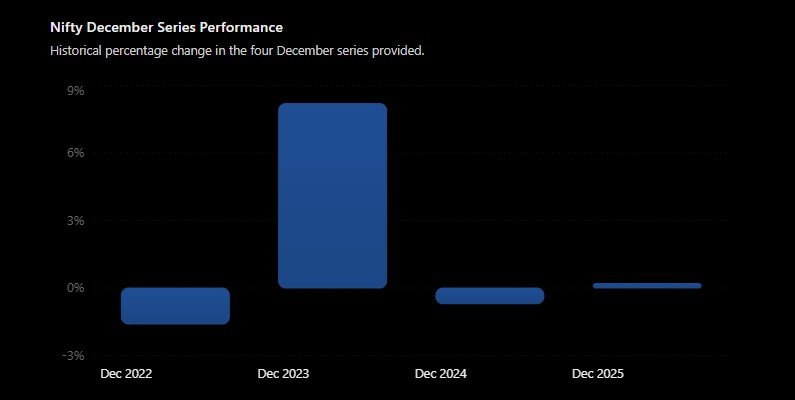
Historical percentage change in the four December series provided.
Recent December Series Performance
| December Series | Nifty Points Change | Percentage |
|---|---|---|
| December 2022 | -293 | -1.6% |
| December 2023 | +1,646 | +8.2% |
| December 2024 | -164 | -0.7% |
| December 2025 | +54 | +0.2% |
The standout performance was December 2023, when Nifty gained 1,646 points, representing an 8.2% advance.
The historical record is encouraging, with 12 positive December closes in the last 18 years.
However, seasonality should be treated as a statistical reference rather than a directional guarantee. December 2026 will ultimately be influenced by actual price action, institutional flows and macroeconomic developments.
6. Nifty Rollover Data: Slightly Above the Three-Month Average
The November-to-December Nifty rollover stands at 75.5%, compared with the three-month average of 74.8%.
| Parameter | Percentage |
|---|---|
| November–December Rollover | 75.5% |
| Three-Month Average | 74.8% |
| Difference | +0.7 percentage points |
The rollover figure is marginally above its recent average.
This indicates that a slightly higher proportion of positions has been carried forward into the December series compared with the three-month average.
The next step will be to monitor how these positions develop as fresh trading activity builds.
7. Major Triggers to Watch During December 2026
December has several important domestic and international events that could influence market direction.
A. RBI Monetary Policy – December 4
The Reserve Bank of India’s monetary policy announcement on December 4 will be an important domestic trigger.
Market participants will monitor the policy decision, interest-rate outlook and commentary on economic conditions.
B. US Federal Reserve – December 9
The US Federal Reserve’s policy outcome on December 9 will be another major event.
Any change in expectations around US interest rates could influence global liquidity, emerging-market flows and investor sentiment towards Indian equities.
C. AI Trade and Nvidia Developments
Developments around artificial intelligence and Nvidia will remain important for global technology sentiment.
Any major developments in the AI investment theme could influence technology stocks and broader global equity markets.
D. Crude Oil and Metal Prices
Commodity prices will also require close monitoring.
-
Rising crude oil prices could influence India’s import bill and inflation expectations.
-
Metal prices could affect commodity-linked stocks and sectoral performance.
-
Changes in global commodity demand could influence broader market sentiment.
E. FII Flows in India
After November’s exceptional institutional buying, December FII activity will be particularly important.
The continuation of strong cash-market buying could provide further support to Indian equities.
However, a reversal in these flows could alter market sentiment.
F. Geopolitical Developments
Global geopolitical developments will remain another important variable.
Any escalation in geopolitical tensions could influence crude oil, commodities, currency markets and global risk appetite.
8. What Should Traders Watch in the December Series?
The November performance has created an interesting starting point for December.
There are several positive indicators:
-
Nifty has delivered its strongest series gain since April 2020.
-
Bank Nifty has recorded its biggest series gain since February 2021.
-
FIIs have purchased approximately ₹1.17 lakh crore in the cash market during November so far.
-
FII long exposure in index futures has increased to 20.1%.
-
Nifty rollovers are marginally above the three-month average.
-
December has historically closed positively in 12 of the last 18 years.
At the same time, traders should not overlook the following:
-
FIIs remain marginally net short in index futures.
-
Client long exposure has declined to 70.2%.
-
The market is entering December after a substantial November advance.
-
RBI and US Federal Reserve announcements could influence volatility.
For traders, the focus should remain on price confirmation, support and resistance levels, rollover behaviour and changes in institutional positioning.
Final Outlook: December 2026 Could Be an Interesting Series
November 2026 has delivered an exceptional performance for Indian equities. Nifty gained 11.4%, Bank Nifty advanced 15%, and FIIs recorded exceptionally strong cash-market buying.
More importantly, FII positioning in index futures has improved considerably, with long exposure reaching 20.1% at the beginning of the December series.
Historical seasonality also offers an encouraging backdrop, with December closing positively in 12 of the last 18 years.
However, the market is entering December after a significant advance. The ability to sustain higher levels, continued FII participation and developments around global monetary policy will be critical.
My key focus for December will be the relationship between price action, FII positioning and Gann time cycles. Historical seasonality provides the background, but actual market confirmation will determine the trading strategy.
The December series has several important events ahead. Traders should remain disciplined, monitor institutional activity and avoid taking directional positions purely on the basis of historical statistics.
Disclaimer
This article is for educational and informational purposes only and should not be construed as investment advice or a recommendation to buy or sell any security or derivative. Bramesh Tech Analysis is not a SEBI-registered investment adviser or research analyst. Trading in equity and derivatives involves substantial risk. Readers should consult their registered financial adviser before making investment decisions.
Bramesh Bhandari
Technical Analyst, Trader, and Educator publishing daily market geometry, W.D. Gann levels, and financial astrology cycles since 2008. Creator of custom TradingView Pine Script scanners for Nifty, Bank Nifty, Gold, and Global Indices.